Five years ago this was an easy question. Builders were for people who couldn't code, and coding was for everyone else. That line has mostly disappeared. Builders like Webflow and Framer now handle things that used to require a developer, and AI coding tools have made custom builds faster than they've ever been. So the honest answer to 'which is better' isn't a platform, it's a set of questions about your business.
We build custom-coded websites for a living, so it would be easy for us to just tell you to always go custom. We're not going to do that, because for a lot of businesses it's the wrong call, and we'd rather you make the right one than the one that pays us more.
What's actually different between the two
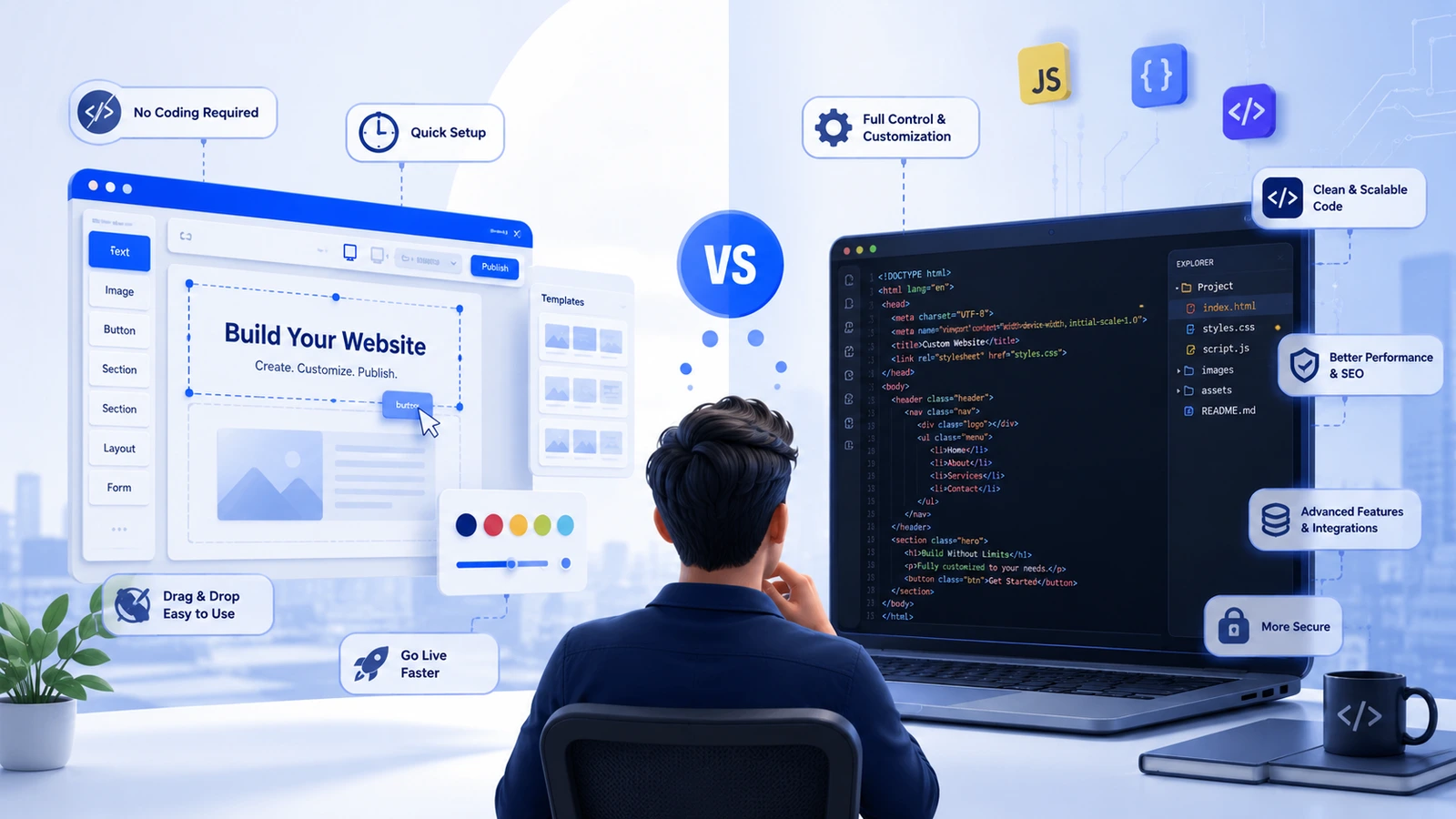
A website builder is a hosted platform, drag, drop, publish. Templates, hosting, and basic security come bundled in. You're working inside whatever that platform allows, nothing more, nothing less.
Coding a website means someone writes HTML, CSS, JavaScript, and usually a backend, specifically for your site. There's no ceiling on what it can do, but there's also no bundle, you're sourcing hosting, security, and every future change separately, from a developer or your own time.
There's an interesting data point buried in a Reddit thread of web designers discussing exactly this: one developer said their client split is roughly 50/50 between fully custom builds and WordPress, and it's rarely anything in between. That tracks with what we see too, the middle ground (heavily customized builder sites) is smaller than people assume. Most businesses land on one side or the other pretty clearly once they actually think it through, rather than sitting on the fence.
What each actually costs
Website builders run $12-50 a month for anything business-grade, so call it $150-600 a year, hosting and security included. Custom development starts around $3,000-8,000 for a straightforward business site and climbs well past $50,000 for anything with real application logic behind it.
The number people miss is what happens after launch. A custom site needs separate hosting, an SSL certificate, and a developer on call for changes, at $75-200 an hour in most markets. Add that up over three years and a 'cheap' custom build can cost more than the builder subscription would have. A redesign a few years down the line adds another chunk on either path, but it tends to hurt more on a custom site since you're paying for developer hours all over again rather than just switching templates.
This is exactly why we scope maintenance costs upfront with clients rather than just quoting a build price, the sticker price on day one is rarely the number that matters most. If you'd like real numbers instead of ranges, our free audit covers this as part of the review.
How long each one takes
A builder site, even a genuinely good one, ships in one to two weeks. Custom builds run six to twelve weeks at minimum, longer the moment scope creep shows up, and it always shows up. AI-assisted coding has closed some of that gap, a developer using Claude Code or similar tools might do in four weeks what took eight a couple of years back, but it's still double or triple a builder timeline.
That gap matters more than it looks on paper. Every week your site isn't live is a week of leads, sales, or search visibility you're not getting. For a seasonal business or a product launch tied to a date, that math can outweigh almost every other factor on this page.
Where a builder is genuinely the right call
Standard business sites, portfolios, and marketing pages. Most e-commerce stores with a normal checkout flow. Anything on a tight deadline or a tight budget. Businesses without an in-house developer that need to change a headline or swap a photo themselves without waiting on anyone.
If every feature on your list already exists as a template or plugin in a modern builder, paying for custom code buys you nothing except a longer wait and a bigger invoice.
Where custom coding earns its cost
Web applications with real user interaction, think dashboards, booking logic, anything closer to software than a brochure. Sites that need to plug into a specific business system a builder simply doesn't integrate with. Projects where page speed has a direct, measurable line to revenue. And anything where the website is the product, not just marketing for one.
If your business fits here, this is where we spend most of our time, and our website development work usually starts with exactly this kind of requirement, a business that's already tried to force-fit a builder and hit a real wall.
Security: who's actually on the hook
With a builder, security patching, server hardening, and SSL are the platform's job, not yours. That's genuinely convenient, but it also means your site's security is only as good as every other site on that platform. When a builder-wide vulnerability surfaces, everyone using it is exposed at the same time.
With custom code, security lives entirely with whoever built and maintains your site. Nobody's patching it for you in the background. That's more responsibility, but it also means your attack surface is unique to you rather than shared with millions of other sites running the same template engine.
SEO, in practice rather than in theory
Modern builders ship with SEO basics handled, meta tags, sitemaps, mobile responsiveness, reasonable page speed out of the box. For most business sites, that's genuinely enough to compete. Where builders fall short is granular technical control, things like custom schema markup, fine-tuned caching rules, or non-standard URL structures, which some platforms simply don't expose to you.
Custom code removes that ceiling entirely, every technical SEO lever is available, but nothing is automatic either. Someone has to actually implement it. In our experience, the platform matters less for SEO than whether anyone is doing the ongoing work, content, backlinks, page speed, on either option.
A quicker way to decide
Skip the philosophy and answer three questions honestly. Does this genuinely require something no builder offers, not 'would be nice,' but actually requires it? Who's maintaining this site in eighteen months, and if it's not a developer on your team, have you priced that in? And what does a three-month delay actually cost you in lost leads or sales?
Most businesses answer their way straight to a builder once they're honest about all three. That's not a knock on custom development, it's just recognizing the tool should match the job. This is also worth reading alongside our post on WordPress vs coding a website, since WordPress often ends up as the practical middle ground between the two.
The hybrid option nobody mentions upfront
A lot of businesses don't pick one forever. A common setup: a builder or CMS running the marketing site and blog, with a custom-coded application handling the part of the business that actually needs it, a booking system, a client portal, whatever's specific to you. Marketing updates their own pages without touching a developer's queue. The dev team only builds what genuinely needs building. Nobody's stepping on anyone's work.
It's also a safer way to start. Launch on a builder, prove the idea works, then move the pieces that need custom code once there's real demand to justify it, instead of betting the whole budget on an unproven idea upfront.
What we tell clients who ask us this exact question
Honestly, the same three questions from above, out loud, in the first call. If someone comes to us wanting a five-page site for a local service business, we'll usually say a builder is the smarter spend and mean it, even though we're a development shop. The clients who end up needing custom work almost always self-identify once they hear the trade-offs, they already suspected a builder wouldn't cut it, they just needed someone to confirm it wasn't overkill to ask.
Bottom line
There's no universally better option here, only a better fit for what you're actually building. A builder gets you online fast, cheap, and independent of a developer for day-to-day changes. Custom code costs more time and money but removes every ceiling on what your site can do. Most businesses, honestly, are better served by a builder or a CMS. Save custom development for the parts of your business that genuinely need it.